The National Hardwood Lumber Association (NHLA) grading system is the universal standard governing American hardwood lumber traded internationally. FAS grade requires 83.3% clear face on the better board face; 1 Common requires 66.7%; 2 Common requires 50%.
Gulf South Forest Products exports American hardwood in all three grades from the Port of Mobile, Alabama, to buyers in more than 50 countries. Request a quote and specify your NHLA grade, species, and thickness to receive current pricing and availability.
Key Takeaways
- The National Hardwood Lumber Association (NHLA), headquartered in Memphis, Tennessee, has published the grading rules governing American hardwood lumber since 1898 — rules that form the basis for international hardwood trade in more than 50 countries worldwide.
- NHLA grades measure the percentage of clear, defect-free wood obtainable from a board face — not the board’s structural strength, appearance uniformity, or color consistency.
- FAS (Firsts and Seconds) is the highest NHLA export grade, requiring 83.3% clear face on both faces of boards measuring at least 6 inches wide by 8 feet long.
- International buyers who specify 1 Common reduce per-board-foot material cost relative to FAS while obtaining 66.7% clear-face yield — sufficient for cabinet door manufacturing, furniture component production, and flooring shorts operations.
What Is NHLA and Why Do Its Grades Matter for Export?
The National Hardwood Lumber Association (NHLA) is the standard-setting body for American hardwood lumber grading, headquartered in Memphis, Tennessee, and founded in 1898. NHLA publishes the Rules for the Measurement and Inspection of Hardwood and Cypress — the grading rulebook that governs how every American hardwood board is measured, inspected, and assigned a grade at the sawmill.
NHLA reviews these rules every four years and publishes the current edition in multiple languages so international buyers can verify grade requirements in their own market.
NHLA grades create a shared commercial language between U.S. sawmills and international buyers — so a furniture manufacturer in Vietnam, a flooring distributor in Germany, and a wholesale importer in Japan can each specify “White Oak FAS” and receive boards that meet identical minimum clear-face percentage, width, and length standards, regardless of which NHLA-certified mill produced the lumber.
Without this shared standard, every international hardwood transaction would require individual board inspection at the U.S. origin mill.
NHLA grades measure one variable: the percentage of each board face that yields clear, defect-free cuttings — rectangular sections free from knots, checks, splits, wane, and stain. NHLA grades do not measure structural strength, appearance uniformity, color consistency, or figure pattern.
Buyers who require color-sorted, figure-matched, or appearance-graded hardwood beyond NHLA minimums must state those supplementary requirements explicitly in the purchase order — NHLA grade alone does not guarantee those attributes.
The International Hardwood Products Association (IHPA), based in Alexandria, Virginia, advocates for U.S. hardwood exporters and publishes market data that Gulf South Forest Products and other major exporters reference when communicating NHLA grade availability and pricing to international buyers.
What Is FAS Grade Lumber and When Should Buyers Specify It?
FAS (Firsts and Seconds) is the highest standard NHLA hardwood grade, producing the longest and widest clear cuttings of any commercially traded American hardwood grade.
An NHLA-certified grader assigns an FAS grade to a board that yields a minimum 83.3% clear face on the better of its two faces, measures at least 6 inches wide by 8 feet long, and produces clear cuttings no smaller than 4 inches by 5 feet or 3 inches by 7 feet.
FAS grade serves buyers whose manufacturing processes require long, wide, defect-free boards — specifically, large-format furniture manufacturers, premium flooring mills, solid-wood door-frame producers, and luxury architectural millwork producers.
A furniture manufacturer cutting solid-wood tabletops or chair back panels from 8/4 boards maximizes clear yield and minimizes shop waste by specifying FAS, so production runs achieve consistent component quality with fewer rejected cuts per container.
FAS Export Shipment Practice — What Buyers Actually Receive
FAS One Face (F1F) is an NHLA grade in which the better board face meets full FAS requirements, while the poorer face meets 1 Common requirements — guaranteeing at least one FAS-quality face per board.
International export shipments of FAS-grade lumber are conventionally shipped as a combination of FAS and F1F boards, commonly assembled at an 80/20 ratio — 80% FAS and 20% F1F — with the exact mix subject to the buyer-seller agreement, according to the American Hardwood Export Council (AHEC).
Buyers who require 100% FAS on both board faces must state this requirement explicitly in the purchase order — an unqualified “FAS” specification permits F1F inclusion at the seller’s standard ratio.
Contact Gulf South Forest Products to confirm current FAS availability by species and thickness and to specify FAS/F1F ratio requirements before issuing a purchase order.
What Is 1 Common Grade, and What Applications Does It Suit?
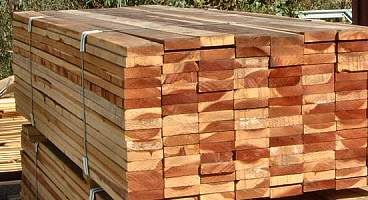
1 Common (No. 1C) is an NHLA hardwood grade that yields a minimum 66.7% clear face on the better board face from boards as narrow as 3 inches and as short as 4 feet.
The U.S. domestic market designates 1 Common as “cabinet grade” because 1C board dimensions align directly with standard kitchen cabinet door sizing — a dimensional match that established 1 Common as the dominant grade for cabinet component production across the United States.
For international export buyers, 1 Common delivers identical clear wood quality to FAS — the cuttings obtained from a 1C board carry the same defect-free wood characteristics as FAS cuttings — but in shorter and narrower pieces.
Buyers who manufacture furniture components, cabinet doors, flooring shorts, or interior millwork profiles that require clear pieces under 4 feet long extract an equivalent production value from 1 Common at a lower per-board-foot material cost than FAS.
When to Specify 1 Common Instead of FAS
Buyers should specify 1 Common rather than FAS when their production cutting pattern requires clear pieces shorter than 4 feet or narrower than 6 inches — the minimum board dimensions that FAS mandates.
A cabinet door manufacturer cutting 18-inch by 30-inch door blanks from 4/4 boards extracts equivalent clear yield from 1 Common boards as from FAS boards — while paying a lower per-board-foot material cost.
Buyers who specify FAS to short-cut production operations overpay for board length and width that their cutting patterns cannot use.
What Is 2 Common Grade and How Is It Used in Manufacturing?
2 Common (No. 2AC, also referred to as 2A Common) is an NHLA hardwood grade that yields a minimum 50% clear face on the better board face from boards as narrow as 3 inches and as short as 4 feet.
The clear cuttings permitted in 2 Common measure a minimum of 3 inches by 2 feet — shorter than the 1 Common minimum cutting of 3 inches by 3 feet — making 2 Common the grade of choice for buyers who cut small, clear furniture components, short molding profiles, turned spindle parts, and flooring strip blanks.
The U.S. domestic hardwood trade designates 2C Common as the “economy grade” because 2C carries the lowest per-board-foot price of the three primary NHLA export grades while still delivering 50% clear wood yield.
International buyers who manufacture high-volume, small-dimension furniture components — drawer pulls, chair rungs, small cabinet parts, short flooring strips — extract acceptable clear yield from 2 Common at the lowest material cost available in the NHLA standard grade structure.
2 Common vs. 1 Common — The Production Decision
The production decision between 2 Common and 1 Common depends on the minimum clear-cutting length required by a buyer’s manufacturing process.
Buyers whose shortest cutting pattern exceeds 3 feet in length should specify 1 Common — 2 Common’s minimum 2-foot clear cutting produces more unusable short pieces than most furniture component operations can absorb.
Buyers whose cutting patterns run consistently under 2 feet in clear length extract maximum board-foot value from 2 Common and pay unnecessarily for 1 Common’s longer minimum cutting requirement.
NHLA Grade Comparison: Side-by-Side Table
| NHLA Grade | Min. Clear Face % | Min. Board Width | Min. Board Length | Min. Cutting Size | Primary Export Use |
| FAS (Firsts and Seconds) | 83.3% (both faces) | 6 inches | 8 feet | 4″×5′ or 3″×7′ | Luxury furniture, wide solid-wood tabletops, door frames, and architectural millwork |
| FAS One Face (F1F) | 83.3% (better face only) | 6 inches | 8 feet | 4″×5′ or 3″×7′ | Single-face furniture components, hardwood flooring, and cabinet door faces |
| 1 Common (1C) | 66.7% (better face) | 3 inches | 4 feet | 4″×2′ or 3″×3′ | Cabinet doors, furniture component parts, flooring shorts, and interior millwork profiles |
| 2 Common (2AC) | 50% (better face) | 3 inches | 4 feet | 3″×2′ | Small furniture components, turned spindle parts, and short molding profiles |
| 3 Common (3AC) | 33.3% (better face) | 3 inches | 4 feet | 3″×2′ | Pallet stock, blocking, utility construction applications |
Critical species exception — American Black Walnut: American Black Walnut (Juglans nigra) carries NHLA-approved species-specific grade exceptions that differ from every other standard American hardwood species.
Black Walnut FAS minimum board size is 5 inches wide by 6 feet long — smaller than the 6″×8′ FAS minimum applied to White Oak, Red Oak, Hard Maple, and all other standard species.
How to Specify the Right NHLA Grade for Your Export Order
International buyers specify NHLA grades in export purchase orders by stating four required elements: species name (e.g., American White Oak, American Red Oak, American Black Walnut); NHLA grade (FAS, 1 Common, or 2 Common); board thickness in quarters (4/4, 5/4, 6/4, or 8/4); and any supplementary requirements beyond NHLA minimums — minimum board width, minimum board length, color sort, or sawing pattern (flat sawn, quarter sawn, or rift sawn).
NHLA grade alone does not fully specify a hardwood export order. A purchase order stating only “White Oak FAS 4/4” permits any board meeting the 6″×8′ FAS minimum — including boards close to the 6-inch width minimum and boards close to the 8-foot length minimum.
Buyers who require wide, long boards for large solid-wood panels or dining tabletop production must state explicit minimum width and length requirements in the purchase order — so the shipment arrives cut-ready for production without regrading at the destination facility.
Gulf South Forest Products supplies American hardwood in FAS, 1 Common, and 2 Common grades across all primary export species — including White Oak, Black Walnut, Red Oak, Hard Maple, Cherry, Ash, and Tulip Poplar — shipped from the Port of Mobile, Alabama, with full NHLA grade documentation on every container.
Gulf South Forest Products ships FAS, 1 Common, and 2 Common American hardwood to any destination port worldwide. Get a quote today and receive a response within one business day.
Frequently Asked Questions
What does FAS grade mean in hardwood lumber?
FAS (Firsts and Seconds) is the highest standard NHLA hardwood grade, requiring 83.3% clear face on the better board face from boards measuring at least 6 inches wide by 8 feet long, as defined by the National Hardwood Lumber Association. FAS grade serves luxury furniture manufacturers, premium flooring mills, and architectural millwork producers who require the longest and widest clear cuttings per board foot.
What percentage of clear face does FAS grade lumber require?
FAS grade American hardwood lumber requires a minimum 83.3% clear face on the better board face, with individual clear cuttings no smaller than 4 inches by 5 feet or 3 inches by 7 feet. Both faces of an FAS board must independently meet the 83.3% clear-face minimum — a requirement that distinguishes FAS from FAS One Face (F1F), which requires 83.3% on the better face only.
Is 1 Common grade lumber suitable for furniture export?
1 Common grade American hardwood suits furniture component manufacturers, cabinet door producers, and flooring shorts buyers who require 66.7% clear face from boards as narrow as 3 inches and as short as 4 feet. Buyers whose production cutting patterns require clear pieces under 4 feet long extract equivalent production value from 1 Common at a lower per-board-foot material cost than FAS grade.
What is the price difference between FAS and 1 Common hardwood?
FAS grade commands a higher per-board-foot price than 1 Common because FAS boards must meet stricter minimum width (6 inches vs. 3 inches), minimum length (8 feet vs. 4 feet), and clear-face percentage (83.3% vs. 66.7%) requirements. The price premium varies by species and current market conditions; buyers confirm current FAS and 1 Common pricing for their specified species by requesting a quote from Gulf South Forest Products.
How do I specify NHLA grades when ordering export lumber?
A complete NHLA grade specification for an export purchase order requires four elements: species name, NHLA grade (FAS, 1 Common, or 2 Common), board thickness in quarters (4/4 through 8/4), and any supplementary requirements beyond NHLA minimums — minimum board width, minimum board length, color sort, or sawing pattern. NHLA grade alone does not constrain board dimensions to production requirements — buyers must state explicit minimums to ensure the shipment arrives cut-ready.
Which NHLA grades are most common in container export orders?
FAS grade is the most commonly specified NHLA grade in American hardwood export containers, particularly among furniture manufacturers in Vietnam, the UK, Germany, Italy, and Japan who require maximum clear-cutting yield per board foot. 1 Common serves volume-export markets, including cabinet component manufacturers and flooring producers. 2 Common fills orders for high-volume, small-dimension furniture component buyers and economy-grade wholesale importers who prioritize material cost over clear-cutting length.