American Black Walnut (Juglans nigra) ships from Gulf South Forest Products in FAS, 1 Common, and 2 Common grades, kiln-dried to 6–8% moisture content, from the Port of Mobile, Alabama, to buyers in more than 50 countries.
Black Walnut carries a Janka hardness of 1,010 lbf and commands the highest per-board-foot export price of any widely traded American hardwood species.
Black Walnut represents less than 5% of the U.S. hardwood forest resource, according to the American Walnut Manufacturers Association (AWMA) — confirm grade availability early. Request a quote before issuing a purchase order.
Key Takeaways
- American Black Walnut (Juglans nigra) carries a Janka hardness of 1,010 lbf and ranks as the highest per-board-foot export price among widely traded American hardwood species as of 2026.
- NHLA applies species-specific grading rules to Black Walnut — FAS minimum board size is 5 inches wide by 6 feet long, smaller than the 6″x8′ standard applied to White Oak, Red Oak, and Hard Maple.
- Gulf South Forest Products ships Black Walnut kiln-dried to 6–8% moisture content, satisfying ISPM 15 phytosanitary entry requirements for all primary destination markets.
- Black Walnut’s sub-5% share of total U.S. hardwood growing stock, per AWMA, limits FAS board availability and extends export lead times relative to higher-volume species such as Red Oak and Hard Maple.
Why Is American Black Walnut the Premium Export Hardwood?
American Black Walnut (Juglans nigra) is a fine-textured hardwood native to the central and eastern United States, growing in scattered stands from the Great Plains east to the Appalachian Mountains.
Black Walnut heartwood ranges from light to dark chocolate-brown with an occasional purplish cast — a color profile that no other commercially available temperate hardwood species replicates at export volume.
Structural testing published by the American Hardwood Export Council (AHEC) confirms Black Walnut delivers good bending strength, moderate stiffness, and documented dimensional stability after kiln-drying to 6–8% moisture content.
Black Walnut machines cleanly on standard carbide tooling, accepts hand-applied oil and wax finishes without blotching, steam-bends with acceptable degrade, and holds carved and routed profile detail with precision.
Luxury furniture manufacturers in Germany, Italy, Japan, and Vietnam specify Black Walnut FAS for solid-wood case goods, live-edge dining tables, and premium veneer faces — applications where no substitute species delivers equivalent color depth, grain character, and finishing response at consistent export grades.
Steamed vs. Unsteamed Black Walnut — A Buyer Specification Decision
Steaming is a pre-kiln heat treatment that darkens Black Walnut’s creamy-white sapwood to approximate the chocolate-brown heartwood color, producing a visually uniform board face across the full width.
Most commercially produced Black Walnut lumber ships steamed as standard. Unsteamed Black Walnut retains the natural sapwood-heartwood color contrast — a specification that European and Japanese buyers producing live-edge and natural-character furniture actively request.
Gulf South Forest Products supplies both steamed and unsteamed Black Walnut; buyers must specify sapwood treatment in the quote request, as unsteamed stock carries longer sourcing windows than steamed material.
What Grades of Black Walnut Are Available for Export?
Gulf South Forest Products exports American Black Walnut in three grades under National Hardwood Lumber Association (NHLA) rules, headquartered in Memphis, Tennessee.
Black Walnut carries species-specific NHLA dimensional exceptions that differ from every other American hardwood — buyers who routinely specify White Oak FAS or Red Oak FAS must review the Walnut-specific minimums before issuing a purchase order.
| NHLA Grade | Min. Width | Min. Length | Clear Face % | Typical Buyer |
| FAS (Firsts and Seconds) | 5 inches | 6–16 ft | 83.3% minimum | Luxury furniture manufacturer, live-edge slab producer, premium veneer mill |
| 1 Common (1C) | 3 inches | 4–16 ft | 66.7% minimum | Furniture component mill, cabinet door manufacturer, architectural millwork producer |
| 2 Common (2C) | 3 inches | 4–16 ft | 50% minimum | Industrial parts cutter, mid-grade furniture component buyer |
NHLA sets the Black Walnut FAS minimum board size at 5 inches wide by 6 feet long — versus the 6 inches wide by 8 feet long minimum applied to White Oak, Red Oak, Hard Maple, and all other standard American hardwood species.
NHLA refined this Walnut-specific rule because Black Walnut trees grow shorter and branch lower than other domestic hardwoods, producing fewer wide, long, clear boards per harvested log. Buyers who specify Black Walnut FAS receive boards that meet the 5″x6′ Walnut minimum — not the 6″x8′ standard that buyers of other species may expect.
Buyers who require boards 7 inches wide or longer, or 10 feet long or longer, must explicitly state the minimum width and length in the Gulf South quote request and anticipate longer sourcing lead times and higher per-board-foot pricing for those specifications.
Contact Gulf South to confirm current FAS availability by width and thickness before issuing a purchase order.
What Are the Technical Specs for Kiln-Dried Black Walnut?
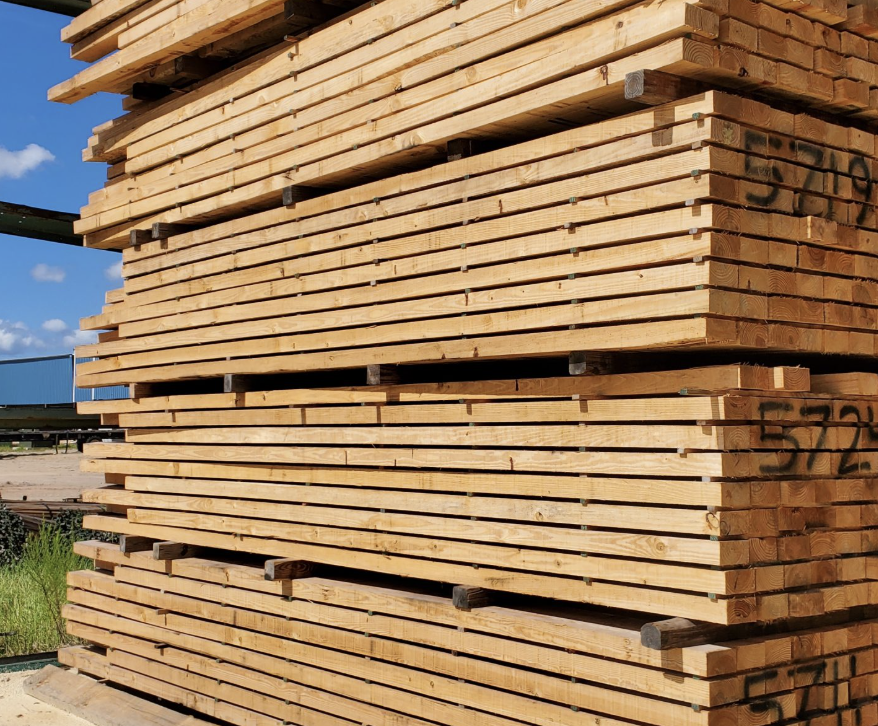
Gulf South Forest Products ships American Black Walnut kiln-dried to 6–8% moisture content, satisfying ISPM 15 — the International Standards for Phytosanitary Measures No. 15 published by the International Plant Protection Convention (IPPC) — governing solid wood movement across national borders.
Kiln-dried Black Walnut at 6–8% moisture content resists mold growth, wood-boring insect activity, and dimensional movement during ocean transit from the Port of Mobile, Alabama, to destination ports in Europe, Asia, the Middle East, and Latin America.
| Specification | Standard Export Value |
| Species | American Black Walnut (Juglans nigra) |
| Janka Hardness | 1,010 lbf |
| Kiln-Dried Moisture Content | 6–8% |
| Available Thicknesses | 4/4, 5/4, 6/4, 8/4 |
| Standard Board Lengths | 4–16 feet |
| Sapwood Treatment | Steamed (standard) or unsteamed (on request) |
| Weight (KD, approximate) | 3.7 lbs per board foot |
| Container Capacity (40-ft, 4/4 KD) | Approximately 10,000–11,500 board feet |
| NHLA Export Grades | FAS, 1 Common, 2 Common |
| Phytosanitary Compliance | ISPM 15 / USDA APHIS certified |
Kiln-dried American Black Walnut weighs approximately 3.7 lbs per board foot, according to USDA Forest Products Laboratory Wood Handbook data — lighter than kiln-dried White Oak at 3.9 lbs per board foot but denser than kiln-dried Tulip Poplar at 2.3 lbs per board foot.
Buyers ordering 8/4 or thicker Black Walnut in full 40-foot container loads must confirm payload limits with their freight forwarder before finalizing order volume.
Which Markets Import the Most American Black Walnut?
Black Walnut export demand is concentrated in four regions, where luxury furniture manufacturing, interior design specifications, and premium veneer production drive consistent wholesale purchasing volumes.
Japan leads American Black Walnut lumber imports by value among individual destination countries, according to NHLA export data. U.S. hardwood lumber exports to Japan reached $75.5 million in 2022, led by Black Walnut consumption, before declining due to Japanese Yen depreciation against the U.S. Dollar through 2023–2024.
Japanese furniture manufacturers and interior designers specify Black Walnut FAS for solid-wood case goods, architectural joinery, and hardwood floor paneling — applications where Black Walnut’s color depth commands verified retail price premiums that are unavailable with domestic Japanese species.
Vietnam ranks as the fastest-growing major Black Walnut destination market, with U.S. hardwood lumber exports to Vietnam growing 23% in 2024, according to AHEC data reported by Miller Wood Trade Publications. Vietnamese furniture manufacturers producing American-style solid-wood case goods for export to North America and Europe specify Black Walnut FAS in 4/4 and 5/4 thicknesses as a primary production material.
Europe — specifically Germany, Italy, and the United Kingdom — imports Black Walnut FAS for luxury furniture production, architectural millwork, and precision gunstock manufacturing. European hardwood lumber imports from the U.S. grew 10% to the rest of the world in the first half of 2024, when China’s volume is excluded, according to NHLA October 2024 export data — with Black Walnut and White Oak driving the majority of premium-grade volume into German and Italian markets.
China imported Black Walnut as its single largest U.S. hardwood log species through 2023, with Walnut representing 30% of all U.S. hardwood log exports to China by volume, according to AHEC data published by Miller Wood Trade Publications. Lumber-form Black Walnut exports to China moderated through 2025 due to elevated bilateral tariff conditions; buyers manufacturing in China must confirm current duty rates with their customs broker before placing Black Walnut orders.
How to Source Black Walnut for International Orders
International buyers, wholesale importers, and furniture manufacturers order American Black Walnut from Gulf South Forest Products by submitting a complete material specification through the Get a Quote form at lumberexport.com.
NHLA grade alone does not capture the width, length, sapwood treatment, and thickness variables that determine whether a Black Walnut shipment meets production requirements — more specification detail is required than for higher-volume species such as Red Oak or Hard Maple.
A complete Black Walnut quote request requires six data points: NHLA grade (FAS, 1 Common, or 2 Common); minimum board width and length when wider or longer than NHLA species minimums; board thickness in quarters (4/4, 5/4, 6/4, or 8/4); sapwood treatment (steamed or unsteamed); estimated order volume in board feet or 40-foot container equivalents; and destination port and country of import.
Gulf South Forest Products returns quotes that include per-board-foot pricing, NHLA grade confirmation, estimated ship date from the Port of Mobile, Alabama, and a complete export documentation package — phytosanitary certificates issued through USDA APHIS, fumigation certificates where required by the destination country, and commercial invoices formatted for customs clearance.
Buyers who require Black Walnut alongside other species in a mixed-species container, or who need specialty forest products combined in the same shipment, contact Gulf South directly to structure the order.
Black Walnut FAS availability is supply-constrained year-round. Gulf South Forest Products ships FAS, 1 Common, and 2 Common Black Walnut from the Port of Mobile, Alabama, to any destination port worldwide. Get a quote today.
Frequently Asked Questions
What NHLA grades of Black Walnut are available for export?
Gulf South Forest Products exports American Black Walnut in FAS, 1 Common, and 2 Common grades under NHLA rules. Black Walnut FAS carries a species-specific minimum board size of 5 inches wide by 6 feet long — smaller than the 6″x8′ FAS minimum that NHLA applies to White Oak, Red Oak, and all other standard American hardwood species.
What is the lead time for an export container of Black Walnut?
Gulf South Forest Products ships stock Black Walnut FAS in 4/4 thickness within four to six weeks from order confirmation. Black Walnut FAS in 8/4 and thicker requires six to eight weeks, as wide, clear boards in those dimensions face sustained domestic demand from slab fabricators and live-edge furniture producers. Buyers must confirm current stock availability with Gulf South before issuing a purchase order.
Which countries import the most American Black Walnut?
Japan led American Black Walnut imports by value in 2022, accounting for $75.5 million of total U.S. hardwood lumber exports, with Black Walnut as the primary species, according to NHLA data. Vietnam, Germany, Italy, and the UK follow as the next largest destination markets by volume. China dominated log-form Walnut imports through 2023, but lumber-form imports moderated through 2025 due to elevated bilateral tariff conditions.
What is the difference between FAS and 1 Common Black Walnut for export?
Black Walnut FAS yields 83.3% clear face on the better board face and serves luxury furniture manufacturers and veneer producers who require maximum clear-cutting yield per board foot. Black Walnut 1 Common yields 66.7% clear face on the better board face and serves furniture component mills and cabinet door manufacturers who accept smaller cutting patterns at a lower per-board-foot material cost.
Is American Black Walnut available kiln-dried for container export?
Gulf South Forest Products ships all Black Walnut export orders kiln-dried to a moisture content of 6–8%, satisfying ISPM 15 phytosanitary requirements for the movement of solid wood across national borders. Mill-issued kiln certificates confirming the drying schedule and final moisture readings are available upon request for every Black Walnut shipment.