Incoterms 2020 are standardized trade terms published by the International Chamber of Commerce that define who pays for shipping, who carries insurance, and where risk transfers between seller and buyer.
Gulf South Forest Products ships forest products under all major Incoterms to buyers in more than 50 countries, and selecting the right term protects your margins on every shipment.
Choosing the wrong Incoterm on a forest products order does not just create paperwork problems — it shifts freight costs, insurance liability, and customs obligations to the wrong party.
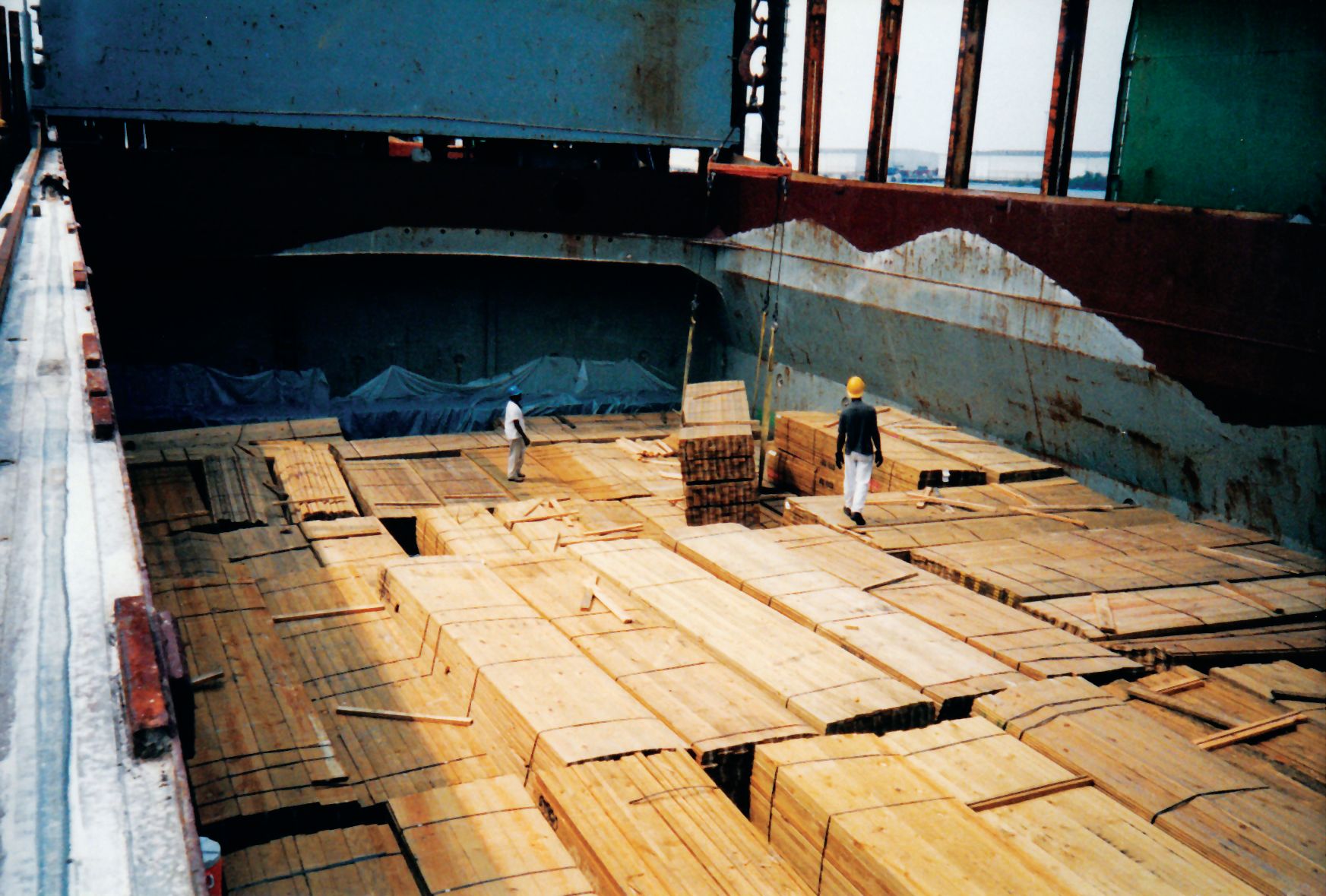
Gulf South Forest Products has exported lumber, poles, logs, mats, panels, and crossties worldwide, shipping from our storage and shipping facility at Blakeley Terminal, Alabama State Docks, Port of Mobile.
Selecting the wrong Incoterm once is expensive. Selecting it wrong repeatedly erodes the margin on every order you place.
What Are Incoterms and Why Do They Matter for Wood Product Imports?
Incoterms (International Commercial Terms) are a set of 11 standardized three-letter trade rules published by the International Chamber of Commerce (ICC) to govern international sales contracts.
The current version, Incoterms 2020, took effect on January 1, 2020, and governs international sales contracts across virtually every industry, including forest products, lumber, and bulk commodity trade.
Each Incoterm defines three things for every shipment:
- Obligations — which party arranges transport, export clearance, and import customs
- Risk — the exact point where loss or damage liability transfers from seller to buyer
- Costs — which party pays freight, insurance, port charges, and destination fees
On a $100,000 lumber shipment, cost allocation differences between EXW and DDP regularly exceed five figures depending on destination and freight rates. Selecting the wrong term is where margins disappear.
| Incoterm | Transport Mode | Risk Transfers At | Who Arranges Main Freight |
| EXW – Ex Works | Any | Seller’s premises | Buyer |
| FCA – Free Carrier | Any | Named handoff point | Buyer |
| CPT – Carriage Paid To | Any | First carrier handoff | Seller |
| CIP – Carriage & Insurance Paid To | Any | First carrier handoff | Seller |
| DAP – Delivered at Place | Any | Named destination | Seller |
| DPU – Delivered at Place Unloaded | Any | Named destination, unloaded | Seller |
| DDP – Delivered Duty Paid | Any | Named destination | Seller |
| FAS – Free Alongside Ship | Sea / Inland Waterway | Alongside vessel | Buyer |
| FOB – Free On Board | Sea / Inland Waterway | On board a vessel | Buyer |
| CFR – Cost and Freight | Sea / Inland Waterway | On board a vessel | Seller |
| CIF – Cost, Insurance and Freight | Sea / Inland Waterway | On board a vessel | Seller |
Is “FOB Dallas” a Valid Incoterm on a Lumber Contract?
No. “FOB Dallas” is not a valid Incoterm under Incoterms 2020, and using it in an international lumber contract creates costly ambiguity.
FOB — Free On Board — applies exclusively to ocean freight and inland waterway shipments under Incoterms 2020. The term requires a named port, and risk transfers once the goods are loaded onto the vessel at that port.
Dallas has no port. A contract reading “FOB Dallas” signals that the parties are mixing U.S. Uniform Commercial Code (UCC) domestic terminology with international trade language — two separate legal frameworks that define FOB differently.
Within the United States, FOB is a domestic term that loosely indicates where title and risk transfer, but it does not identify who pays freight charges, does not require a named port, and carries no export clearance obligations.
Under Incoterms 2020, FOB requires the seller to obtain export clearance, a named load port, and risk transfer at the time the goods are loaded onto the vessel.
The correct Incoterm for most containerized lumber shipments — including those originating from the Port of Mobile, where Gulf South ships — is FCA, not FOB.
FOB vs. FCA: Which Incoterm Is Right for Containerized Lumber Shipments?
FCA (Free Carrier) is the Incoterm the ICC recommends for containerized cargo, and it is the correct choice for most Gulf South Forest Products shipments.
FOB (Free On Board)
- Applies to ocean and inland waterway shipments only
- Seller loads goods directly onto the vessel
- Risk transfers at the ship’s rail at the named load port
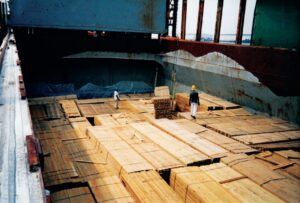
- Designed for bulk cargo and break-bulk shipments, not containers
- Does not work cleanly with Letters of Credit under the original structure
FCA (Free Carrier)
- Works for any transport mode — ocean, truck, air, or rail
- Seller delivers goods to a named location (seller’s warehouse, container terminal, or freight forwarder’s facility)
- Risk transfers at the named handoff point
- Correct for containerized shipments
- Incoterms 2020 added a provision allowing the buyer to instruct the carrier to issue an on-board Bill of Lading to the seller, resolving the previous Letter of Credit incompatibility
For lumber buyers using Letters of Credit: under Incoterms 2020, FCA now supports on-board Bill of Lading issuance, which means your bank can be satisfied without forcing you onto FOB terms that do not match your shipment type.
Incoterms That Matter Most for Forest Product Buyers
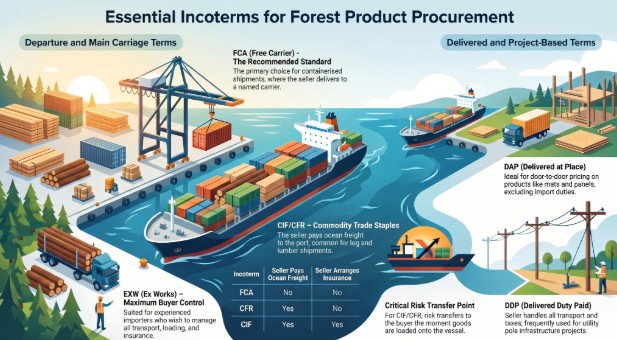
EXW – Ex Works. EXW places maximum responsibility on the buyer. Gulf South makes forest products available at our facility or storage location; the buyer arranges all transport, export clearance, loading, and insurance from that point.
EXW suits experienced importers with their own freight forwarder relationships who want full control over logistics costs.
FCA – Free Carrier FCA is the recommended starting point for most buyers. Gulf South delivers goods to the buyer’s named carrier — typically at our Port of Mobile storage facility at Blakeley Terminal — with export formalities completed.
The buyer contracts and pays the main ocean freight from that point. FCA is the ICC-recommended term for all containerized and multi-modal shipments.
CIF – Cost, Insurance and Freight Under CIF, Gulf South pays ocean freight and arranges minimum insurance coverage to the named destination port. Risk transfers to the buyer once logs, lumber, or poles are loaded onto the vessel at the Port of Mobile, even though Gulf South continues to pay freight to the destination.
CIF is common in the commodity lumber trade and suits buyers who prefer a single delivered price to their import port.
CFR – Cost and Freight CFR mirrors CIF without the insurance requirement. Gulf South pays ocean freight to the destination port; the buyer arranges their own cargo insurance. Risk transfers at loading. CFR suits buyers who carry their own marine insurance on inbound shipments.
DAP – Delivered at Place Under DAP, Gulf South delivers goods to a named location in the buyer’s country — a warehouse, distribution yard, or processing facility — with all freight and export clearance costs covered.
The buyer handles import duties and customs clearance at the destination. DAP suits buyers sourcing mats, panels, or crossties who want a door-to-door price without managing main carriage logistics.
DDP – Delivered Duty Paid Under DDP, Gulf South arranges transport, export clearance, main ocean freight, and pays all import duties and taxes at the buyer’s destination. DDP delivers the goods cleared and ready to use.
Available by arrangement on qualifying orders and destinations. Buyers sourcing utility poles or specialty products for infrastructure projects frequently request DDP terms.
Three Rules Every Lumber Importer Should Follow
Incoterm misuse costs money. These three practices eliminate the most common and expensive mistakes in international forest product contracts:
1. Always state the Incoterms version year.
Write the full term, named location, and version in every contract and commercial invoice — for example: CIF Yokohama (Incoterms 2020). Contracts that omit the version year create disputes when the buyer and seller are unknowingly operating under different editions.
2. Stop using FOB for containerized shipments.
FOB applies to bulk and break-bulk ocean cargo loaded directly onto a vessel. Containerized lumber and panels — the majority of Gulf South’s shipments — move under FCA. Using FOB on a container shipment means risk may technically transfer before the container reaches the vessel, leaving a gap in liability coverage at the container terminal.
3. Name the specific location, not just the city.
“DAP Yokohama” is incomplete. “DAP Yokohama Distribution Warehouse, 1-1 Minato, Naka-ku, Yokohama (Incoterms 2020)” eliminates ambiguity about where delivery obligations end.
The same principle applies to load ports: “FCA Blakeley Terminal, Alabama State Docks, Port of Mobile, AL, USA (Incoterms 2020)” is the precise format.
Gulf South Forest Products Ships to Any Destination Port
Gulf South Forest Products has shipped lumber, utility poles, logs, mats and panels, crossties, and specialty products to buyers in more than 50 countries from our storage and shipping facility at the Alabama State Docks in the Port of Mobile.
Our team structures shipment terms to match your import requirements, Letter of Credit conditions, and logistics setup.
If you’re sourcing forest products from the United States and need a supplier with export experience to get the right terms from the contract stage, contact Gulf South Forest Products for a quote.
Frequently Asked Questions
What are Incoterms 2020 and how do they apply to lumber shipments?
Incoterms 2020 are 11 standardized trade terms published by the International Chamber of Commerce that define freight responsibility, insurance obligations, and risk transfer points in international sales contracts. Lumber and forest product buyers use Incoterms 2020 to structure contracts that clearly assign costs and liability on every shipment.
What does FOB mean in an international lumber contract?
FOB (Free On Board) means the seller loads lumber onto a named vessel at a named port, transferring risk to the buyer at that point. FOB applies only to ocean and inland waterway shipments under Incoterms 2020 — not to truck, air, or rail freight.
Is FOB valid for containerized lumber exports from the United States?
FOB is not the correct term for containerized lumber exports. The International Chamber of Commerce recommends FCA (Free Carrier) for all containerized shipments because, under FOB, risk transfers at the vessel, leaving a liability gap while the container sits at the terminal before loading.
What is the difference between FOB and FCA in forest product shipping?
FOB applies only to ocean freight and transfers risk at vessel loading. FCA applies to any transport mode and transfers risk upon Gulf South’s delivery of goods to the buyer’s named carrier. The ICC recommends FCA for containerized lumber and forest product shipments, rather than FOB.
What Incoterm should a lumber importer use when paying by Letter of Credit?
Lumber importers paying by Letter of Credit can use FCA under Incoterms 2020. A 2020 revision allows the buyer to instruct the carrier to issue an on-board Bill of Lading to the seller, satisfying Letter of Credit documentation requirements without reverting to FOB terms.
What does CIF mean when buying lumber from a U.S. exporter?
CIF (Cost, Insurance and Freight) means the U.S. exporter pays ocean freight and arranges minimum insurance to the buyer’s named destination port. Risk transfers to the buyer at the load port when goods are placed on the vessel, even though the seller pays onward freight.
What is EXW, and when should a forest product buyer use it?
EXW (Ex Works) means the seller makes goods available at their facility and the buyer handles all transport, export clearance, and insurance from that point. Forest product buyers should use EXW only when they have an established freight forwarder and want full control over logistics costs.
What does DDP mean, and when does Gulf South offer it?
DDP (Delivered Duty Paid) means the seller arranges transport, export clearance, ocean freight, and pays all import duties at the buyer’s destination. Gulf South Forest Products offers DDP by arrangement on qualifying orders, delivering lumber and forest products fully cleared and ready to use at the destination.
Why does the version year matter when writing an Incoterm in a contract?
The version year matters because Incoterms are revised periodically, and different editions assign obligations differently. A contract without the version year creates disputes when both parties reference different editions. Every contract should state the full term, named location, and version year — for example, CIF Yokohama (Incoterms 2020).